
 Diuretic Resistance: Why Furosemide Sometimes Fails
When the Loop Stops Working: Mechanisms Revealed
A patient leans on the bed, expecting relief, and finds the loop diuretic less forgiving. Furosemide's apparent failure often starts before the kidney: poor absorption from gut edema, concurrent food or antacids, and low oral bioavailability reduce the delivered dose.
Even when absorbed, furosemide must reach the tubular lumen via organic anion transporters; reduced renal perfusion, competitive secretion, or hypoalbuminemia limit active secretion into the proximal tubule. Without adequate luminal concentration, natriuresis falters.
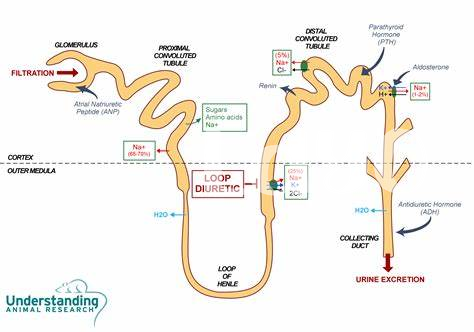
Kidney adaptation also plays a role: chronic loop exposure triggers distal nephron hypertrophy and upregulation of sodium transporters, the so‑called braking phenomenon. Enhanced distal reabsorption can blunt diuretic response even with correct dosing.
Clinicians must recognize these mechanisms to tailor therapy: optimize absorption or use IV dosing, correct hypoalbuminemia when possible, combine with thiazide‑type diuretics, and address underlying hemodynamics to restore efficacy and monitor urine output closely.
| Mechanism | Effect |
|---|---|
| Poor absorption | Reduced dose reaching tubule |
| Distal adaptation | Blunted natriuresis |
How Pharmacokinetics and Absorption Undermine Furosemide
At the bedside a dose feels powerless: a swallowed pill doesn't guarantee effect. Oral furosemide shows highly variable absorption and bioavailability, especially with gut edema or after meals. Enteric dysfunction and delayed gastric emptying slow onset, so the expected diuresis may never materialize despite dosing.
The drug’s journey continues into plasma binding and renal secretion. Furosemide must be secreted into the proximal tubule by organic anion transporters to reach its luminal target; low secretion in chronic kidney disease or competition from other OAT substrates reduces delivery. Hypoalbuminemia raises free fraction but can paradoxically blunt efficacy.
Recognizing these pharmacokinetic pitfalls shifts management: switch to IV dosing or continuous infusion for delivery, adjust timing to meals, check albumin and interacting drugs such as NSAIDs, and consider higher or split dosing guided by urine output and creatinine to overcome absorption and transport limitations.
Kidney Adaptation and the Braking Phenomenon Explained
At first, diuresis surges — a patient feels relief as excess fluid drains away — but the kidney quietly fights back. Tubular cells increase sodium reabsorption downstream from the loop, and neurohormonal systems like RAAS and sympathetic tone amplify retention, blunting furosemide effect.
Over hours to days the distal nephron remodels: hypertrophy and upregulation of transporters raise the capacity to reclaim salt. This adaptive 'braking' reduces natriuresis despite ongoing dosing, creating the familiar plateau in urine output clinicians dread.
Recognizing this physiology matters: alternating diuretics, using natriuretic adjuncts, or adjusting timing can overcome adaptation. Monitoring weight, electrolytes, and urine response guides safer escalation while acknowledging that the kidney’s 'brake' is reversible, not permanent in most cases clinically.
Impact of Comorbidities and Concomitant Medications
Chronic conditions like heart failure, liver cirrhosis and chronic kidney disease change the playing field, altering fluid distribution, renal perfusion and diuretic delivery to the tubule. In congestive heart failure, low cardiac output reduces renal blood flow and diminishes furosemide secretion into the proximal tubule; in cirrhosis, splanchnic vasodilation traps sodium and water. Diabetes and hypoalbuminemia also blunt diuretic effect by changing tubular dynamics and drug binding.
Concomitant drugs — NSAIDs, ACE inhibitors, or albumin-binding medications — can further blunt response by reducing prostaglandin-mediated renal blood flow or competing for secretion pathways. Polypharmacy risks also include drug interactions that alter absorption and metabolism, so reviewing medication lists and correcting reversible factors is essential before escalating therapy. Tailoring dose timing and considering alternative agents often restores responsiveness. Close monitoring of electrolytes and renal function guides safe adjustments and prevents harm in vulnerable patients.
Strategies to Overcome Resistance: Combination and Dosing
Clinicians often face a patient whose edema stubbornly persists despite furosemide. Start by revisiting dose timing and route: sometimes switching from oral to IV or giving a higher single dose unlocks natriuresis. Small, attentive adjustments can turn frustration into measurable diuresis within hours and recovery.
Combination therapy is practical: adding a thiazide-type diuretic before the loop can block distal sodium reabsorption and restore response. Alternately, continuous IV infusion maintains steady concentrations when absorption or peak effects are limited. Monitor electrolytes closely to avoid hyponatremia and hypokalemia too.
Dose escalation should be balanced with renal function and hemodynamics: larger or more frequent doses sometimes overcome the braking phenomenon, but combining modalities or using albumin in hypoalbuminemic patients may help. Individualize plans and reassess urine output hourly and document clinical response.
| Combination | Rationale |
|---|---|
| Thiazide | Block distal reabsorption |
| Continuous IV | Steady plasma levels |
When to Escalate Care: Monitoring and Alternatives
As urine output stalls and edema persists, clinicians must pivot from waiting to active reassessment. Track trends: daily weights, strict intake-output, electrolytes, creatinine, and spot urinary sodium provide objective clues. Rapid fall in urine or rising creatinine despite high-dose oral loop therapy signals need for timely intervention rather than dose escalation alone.
Practical steps include converting to intravenous administration, giving a continuous infusion, or adding a distal-acting agent such as a thiazide diuretic to overcome tubular adaptation. Consider albumin for hypoalbuminemic patients to improve delivery. Monitor potassium and magnesium closely when combining agents to prevent arrhythmia.
If response remains inadequate, escalate consultation to nephrology or heart-failure specialists and evaluate renal replacement strategies including ultrafiltration. Use objective goals—symptomatic relief, weight loss, congestion markers—and reassess after each intervention. Timely escalation reduces complications and aligns care with patient-centered outcomes and preserves organ function.